
- June 29, 2026
- By
- In Brakes
- 4
- 0
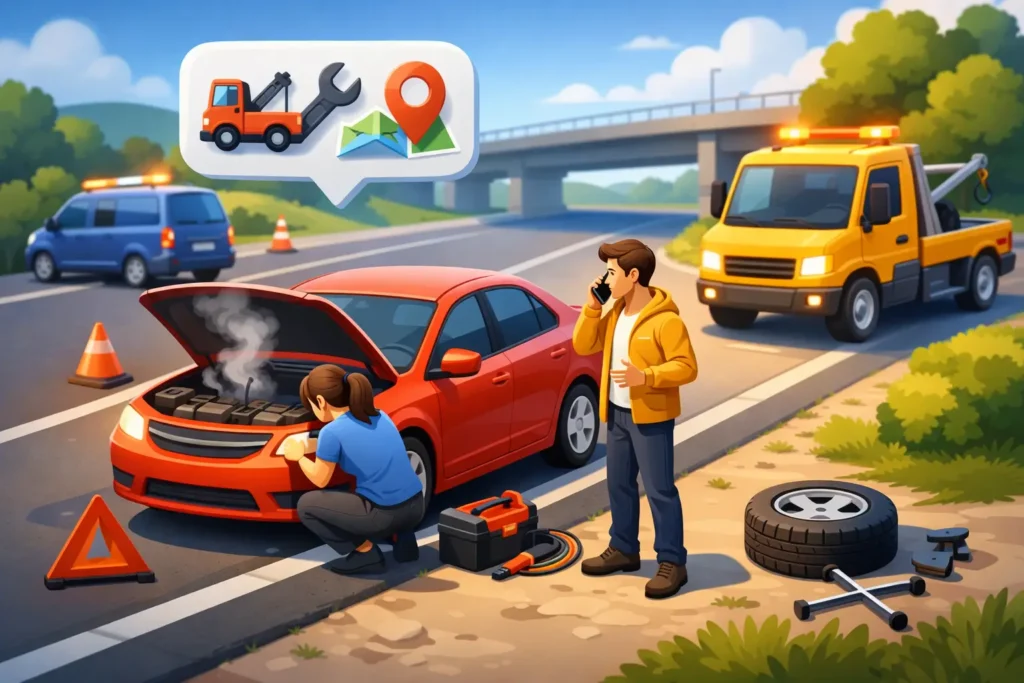
A warning light comes on in traffic, or your car suddenly loses power on a busy road. That moment can rattle anyone. Knowing how to handle roadside car trouble gives you a better chance of staying safe, protecting your vehicle, and getting back on the road without making a stressful situation worse.
The first priority is always safety, not diagnosis. If the vehicle is still moving, ease off the accelerator, turn on your hazard lights, and guide the car to the shoulder or another safe area away from traffic. A parking lot, wide shoulder, or side street is better than stopping in a lane whenever possible. If you are on a highway and the car will not go much farther, avoid sudden braking or sharp steering and focus on getting as far out of traffic as you can.
Once stopped, put the car in park, set the parking brake, and take a breath before doing anything else. If traffic is close and fast, it is often safest to stay inside the vehicle with your seat belt on until help arrives. If you can exit safely and you are well away from moving traffic, step out on the passenger side if possible. At night or during bad weather, visibility becomes a bigger concern, so keep hazard lights on and use reflective triangles or road flares only if you can place them without putting yourself at risk.
Many drivers feel pressure to figure out the exact problem right away. In reality, roadside situations are usually handled best by narrowing things down. Start with what the car is doing. Does the engine crank but not start? Did you hear a pop and then feel the steering pull? Is steam coming from under the hood? Those clues matter more than trying to play mechanic on the shoulder.
Look at the dashboard and notice any warning lights or temperature readings. Listen for unusual sounds such as clicking, grinding, or hissing. Check whether you smell gasoline, burning rubber, or something electrical. If you suspect a fuel leak, smoke, or fire risk, move away from the vehicle and call for emergency assistance. That is not the time for trial and error.
In less urgent situations, a quick visual check can help. A visibly flat tire, loose battery terminal, or broken belt may explain the issue. But avoid reaching into tight engine compartments or touching hot components. Modern vehicles pack a lot into a small space, and a roadside inspection should stay limited and cautious.
A flat tire is one of the most common issues, and whether you should change it yourself depends on the location and the conditions. If you are on a narrow shoulder, soft ground, or heavy-traffic road, calling for roadside help is often the smarter choice. A tire change only makes sense if you have a spare in usable condition, the right tools, and a safe place to work. If any of those pieces are missing, forcing it can create a bigger problem.
A dead battery is another frequent cause of breakdowns. If you have jumper cables and another vehicle available, a jump-start may get you moving again. Even then, there is a trade-off. A battery can die because it is old, because the alternator is failing, or because a light was left on. If the car starts but electrical issues continue, or it dies again soon after, you likely need more than a quick jump.
Overheating needs a careful response. If the temperature gauge climbs or steam appears, turn off the air conditioning and, if the engine still runs, turn on the heater to help pull heat away. Get off the road and shut the engine down as soon as it is safe. Do not remove the radiator cap while the engine is hot. That can cause serious burns. Overheating can come from low coolant, a failing thermostat, a bad water pump, or a leak, so adding coolant is not always a complete fix.
Brake trouble is more urgent. If the pedal feels soft, goes low, or the car does not stop normally, reduce speed, use hazard lights, and move off the road carefully. Pumping the brakes may help in some cases, but if braking performance is clearly compromised, the vehicle should not be driven farther than necessary to reach safety. The same goes for major steering issues, severe vibration, or a loud knocking from the engine.
A calm, limited response is usually the right one. If you have a flat and the area is safe, check the spare tire before removing the damaged tire. Some drivers go through the work of changing it only to find the spare is underinflated or damaged too. If the spare is a compact temporary tire, remember it is meant for short-distance, lower-speed driving, not business as usual.
If the battery appears to be the issue, inspect for obvious corrosion or a loose connection, but do not force anything. A loose terminal may be tightened if you have the proper tool and know what you are doing. If not, it is better to call for assistance than risk electrical damage or injury.
For overheating, wait until the engine cools down fully before checking coolant level in the overflow reservoir. If the reservoir is low and you have the correct coolant or clean water in an emergency, adding some may help you get to a repair shop, but only if there is no visible leak, no heavy steam, and the engine temperature returns to normal. If it overheats again, stop driving.
Small fixes can help in the right situation, but roadside work has limits. Busy roads, Texas heat, rain, and low visibility all change the equation. A problem that looks simple in a driveway can become dangerous on the shoulder.
Knowing when not to push your luck is a big part of how to handle roadside car trouble well. Call for roadside assistance if you are in an unsafe location, do not know what failed, do not have the right tools, or the vehicle shows signs of a serious mechanical problem. Smoke, fluid leaks, overheating that returns, brake failure, and repeated stalling all fall into that category.
It also makes sense to call if you are traveling with children, have a medical concern, or are stuck in severe weather. Convenience matters, but safety matters more. There is no reward for turning a manageable breakdown into an emergency because you wanted to save a service call.
If you do call for help, be ready with your location, vehicle make and model, and a short description of the problem. Landmarks, mile markers, and nearby intersections help much more than saying you are somewhere on the highway. If you are in the Spring, Texas area, working with a local shop that provides roadside support can make the process faster and less frustrating.
Preparation changes everything. A basic roadside kit should include a flashlight, jumper cables, a tire pressure gauge, a portable phone charger, bottled water, and a first-aid kit. It is also smart to keep a reflective vest, gloves, and your wheel lock key if your vehicle uses locking lug nuts. During hot months, extra water matters more than most drivers realize.
Just as important, keep up with maintenance before a breakdown happens. Tires, belts, hoses, battery condition, brake wear, and fluid levels are often the difference between a close call and a tow truck. Regular inspections catch many of the problems that strand drivers on the roadside in the first place.
That is especially true for commuters and families who depend on one vehicle every day. A weak battery may still start your car at home and fail later in a parking lot. Worn tires might feel fine until one lets go in summer heat. Preventive service is usually less expensive and much less disruptive than emergency repairs.
Even if the car restarts or the spare gets you back on the road, treat the incident as a warning sign. Temporary fixes are temporary. A jump-start does not tell you whether the battery or charging system caused the failure. A low coolant condition does not explain why coolant was low. A spare tire does not replace proper tire repair or replacement.
If your vehicle has had roadside trouble, schedule an inspection as soon as possible. A qualified technician can confirm the cause, check for related damage, and help prevent the same issue from happening again. At 360 Auto, that kind of follow-through is part of taking care of our neighbors, not just their cars.
When something goes wrong on the road, the best response is usually the calm one: protect yourself first, avoid guesswork, and get the right help when the situation calls for it. A little preparation and good judgment can turn a bad moment into a manageable one.


