
- May 28, 2026
- By
- In Brakes
- 9
- 1
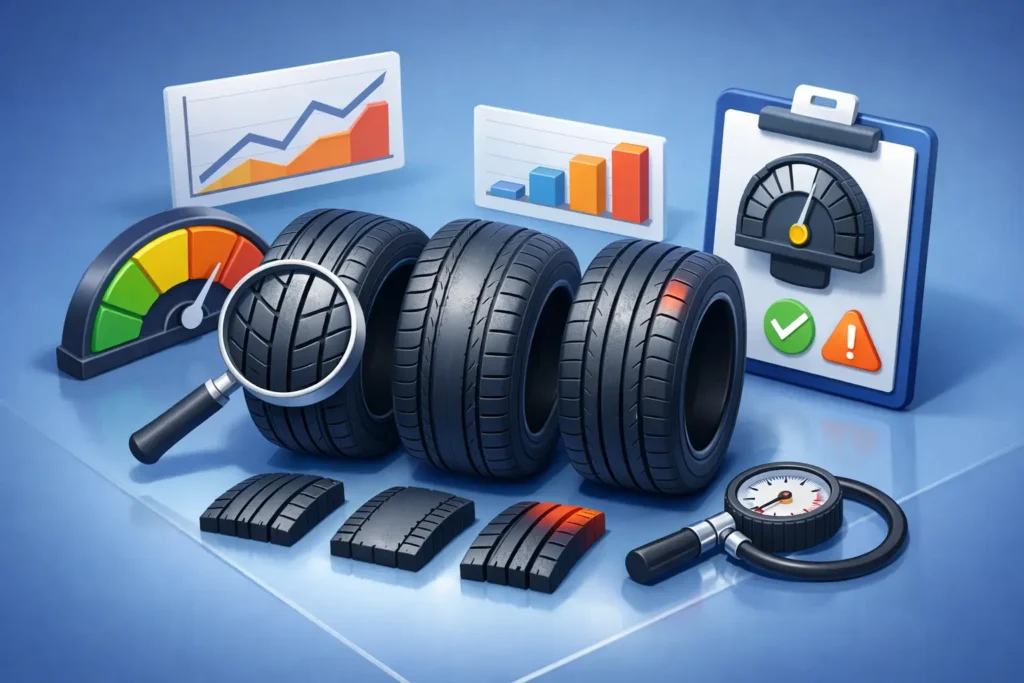
A quick glance at your tires can tell you more about your vehicle than most drivers realize. If you know how to read tire wear, you can catch alignment problems, inflation issues, and worn suspension parts before they turn into bigger repair bills or a roadside headache.
Your tires are the only part of your vehicle that touches the road, so they react to every steering input, braking habit, bump, and maintenance issue. When the tread wears evenly, that usually means your vehicle is rolling as it should. When the wear looks uneven, the tire is often pointing to a problem somewhere else.
That is why tire wear should never be treated as just a tire problem. In many cases, it is a symptom. Replacing the tire without addressing the cause can leave you right back in the same position a few months later.
You do not need to be a technician to do a basic check. Start with the vehicle parked on a flat surface and the wheels turned enough that you can see the tread clearly. Look across the full width of each tire, not just the outer edge.
Run your hand lightly over the tread. You are checking for smoothness, sharp edges, dips, and high spots. Then compare all four tires. A pattern that shows up on only one tire often points to a specific corner of the vehicle, while the same pattern on both front tires may suggest a system-wide issue like inflation or alignment.
Also check tread depth. If the grooves are getting shallow, your stopping distance can increase, especially in rain. Many tires have built-in wear bars that become visible when tread gets too low. If the tread is level with those bars, it is time to replace the tire.
If the middle of the tread is wearing out faster than both edges, the tire is usually overinflated. Too much air causes the center of the tire to carry more of the load, so it wears down first.
This one is fairly straightforward, but there is a trade-off. A slightly firmer tire may improve fuel economy a bit, but too much pressure reduces traction and causes premature wear. Always use the tire pressure listed on the driver-side door sticker, not the maximum pressure printed on the tire sidewall.
If both outer edges are wearing faster than the center, the tire is often underinflated. When air pressure is too low, the outer shoulders carry more of the vehicle’s weight.
Underinflation can also make your vehicle feel sluggish or less responsive in turns. It increases heat buildup in the tire as well, which is never something to ignore in Texas driving conditions.
If only the inside edge or outside edge is wearing faster, that usually points to an alignment issue. Camber settings can cause one side of the tread to do more work than the other.
Inside edge wear is especially easy to miss because it is less visible unless you look carefully. That is one reason regular inspections matter. Drivers often discover inside wear only when the tire is already close to failure.
Cupping looks like a series of dips around the tread. Instead of wearing smoothly, the tire develops uneven low spots. This pattern often suggests worn shocks or struts, suspension looseness, or wheel balance issues.
You may hear more road noise with cupped tires, almost like a humming or droning sound that gets louder at speed. Replacing the tire may be necessary, but the suspension issue needs attention too or the new tire can wear the same way.
Feathering happens when the tread ribs feel smooth in one direction and sharp in the other. It is commonly linked to improper toe alignment. In simple terms, the tires are not pointed exactly where they should be, so they scrub the road surface as they roll.
This kind of wear can develop gradually, and many drivers notice the noise before they notice the tread pattern. If your tires sound louder after a recent pothole hit or curb contact, feathering is worth checking for.
If wear looks irregular, diagonal, or random across the tread, the cause can be harder to pin down without a closer inspection. Tire balance, suspension movement, alignment drift, or even infrequent rotation can all play a role.
This is where experience matters. Some patterns overlap, and a technician may need to inspect the suspension, steering, and tire condition together to identify the root cause.
Learning how to read tire wear is really about understanding what your car is trying to tell you. Uneven wear can point to several issues beyond the tire itself.
Alignment problems are one of the most common causes. If your vehicle pulls to one side, the steering wheel sits off-center, or you recently hit a pothole, alignment should be on your radar. Even a small alignment change can shorten tire life.
Suspension wear is another major factor. Shocks, struts, ball joints, and bushings all help keep the tire planted evenly on the road. When those parts wear out, the tread can start wearing in patterns that look strange or noisy.
Inflation is the easiest part for most drivers to manage, but it still gets overlooked. Tire pressure changes with temperature, and many people wait until a warning light comes on. By that point, the tire may already be wearing incorrectly.
Driving habits matter too. Hard cornering, frequent sudden braking, and carrying heavy loads can all accelerate wear. That does not always mean something is mechanically wrong, but it does affect how long your tires last.
Some tire wear is gradual and manageable. Some deserves attention right away. If you see cords showing, deep cracks, bulges, or severe inside-edge wear, do not keep putting it off.
A tire can look acceptable from one angle and still be unsafe. That is especially true when wear is concentrated on the inner edge or when one area of the tire is much lower than the rest. Those conditions can reduce grip, increase blowout risk, and make wet-weather driving less predictable.
If your vehicle starts shaking at highway speeds, pulling during braking, or making new tire noise, it is smart to have it checked sooner rather than later. Waiting usually turns a smaller correction into a more expensive repair.
The best prevention is consistency. Check tire pressure regularly, rotate your tires on schedule, and pay attention to any change in ride quality, steering feel, or road noise.
It also helps to have your alignment checked when new tires are installed or after a hard impact with a pothole or curb. If suspension parts are worn, replacing tires without fixing those parts is rarely money well spent.
Routine inspections are what save most drivers money in the long run. A simple look at tread depth and wear pattern during an oil change or maintenance visit can catch problems before they become a safety issue.
For drivers around Spring who want clear answers without the guesswork, a trusted local shop can inspect the tires, verify pressure, check alignment angles, and look for suspension wear all in one visit. That kind of complete approach helps you protect both your tires and your vehicle.
Take a minute once a month to look closely at all four tires. It is one of the easiest checks you can do, and it can reveal problems long before they affect your daily commute, weekend plans, or family safety. When you know how to read tire wear, you are not just looking at rubber – you are getting an early warning system for the rest of your vehicle.


1 COMMENT
Why Is My Steering Wheel Vibrating? – 360 Auto
May 30, 2026, 2:09 am REPLY[…] Uneven tire wear is another common issue. Tires that are cupped, feathered, or worn irregularly may not roll smoothly. In some cases, the tire itself may have internal damage, such as a shifted belt, which can create a vibration that balancing alone will not fix. […]