
- April 15, 2026
- By
- In Brakes
- 14
- 0
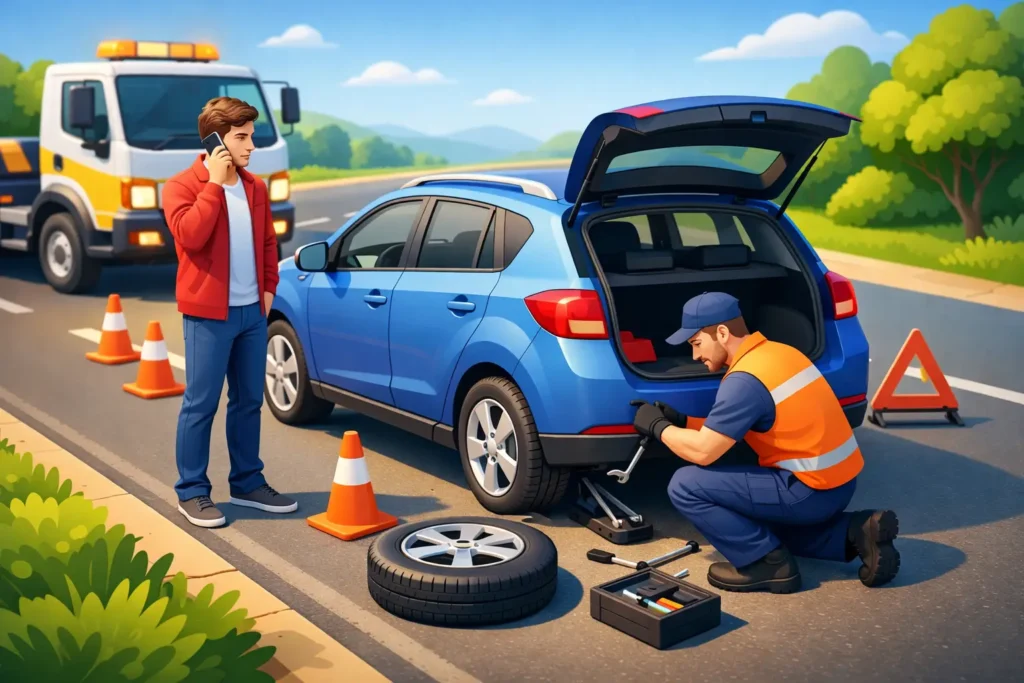
A flat tire rarely happens at a convenient time. It shows up on the way to work, during school pickup, or when you’re already running late. When that happens, roadside assistance for flat tire service can save you time, reduce stress, and help you avoid making a bad situation worse on the side of the road.
For many drivers, the biggest issue is not just the flat itself. It is the uncertainty that comes with it. You may not know whether the tire can be repaired, whether your vehicle even has a spare, or whether changing it yourself is safe where you are parked. That is where professional help matters.
Some drivers are comfortable changing a tire on their own. Others have done it before but would rather not try it on a narrow shoulder, in heavy traffic, or at night. Both situations are reasonable.
Roadside assistance is often the better option when your vehicle is in an unsafe location, the weather is poor, or you do not have the right tools. It also makes sense if the lug nuts are stuck, the spare is underinflated, or your vehicle uses a tire inflator kit instead of a full-size spare. Many newer vehicles do not come with a traditional spare tire at all, which surprises a lot of people when they need one most.
There is also the simple reality that not every flat is equal. A small puncture from a nail is different from sidewall damage, a bent wheel, or a tire that failed after being driven too long while underinflated. A quick roadside tire change may get you moving again, but it does not always solve the underlying problem.
In most cases, roadside assistance for a flat tire means a technician comes to your location, inspects the situation, and either installs your spare tire or helps move the vehicle to a repair facility if the tire cannot be safely changed on site.
That sounds straightforward, but there are a few details worth understanding. If you have a usable spare, the service is usually focused on getting that spare mounted so you can drive a limited distance. If you do not have a spare, roadside support may shift to towing or transport instead. If the tire damage is severe or the wheel is damaged, a spare may still not be the safest next step.
Temporary spares also come with limits. They are not built for long highway trips, heavy loads, or normal daily driving for extended periods. They are a short-term solution meant to get you to a shop for proper tire service.
The first step is safety. Slow down gradually, avoid sudden braking, and move to a secure location if possible. A parking lot is better than a shoulder. A wide shoulder is better than a narrow one. If the car feels unstable, stop as soon as you can do so safely.
Turn on your hazard lights right away. If you have reflective triangles or road flares, use them if conditions allow. Stay aware of traffic, especially if you are near a busy road. If you are in an area with poor visibility, inside a curve, or close to fast-moving traffic, it is often safer to remain inside the vehicle with your seatbelt on while waiting for help.
Before anyone starts changing the tire, the vehicle needs to be on firm, level ground. That is one reason roadside service is valuable. Jacking up a car on soft ground, gravel, or an incline can be dangerous, even if you have changed tires before.
A lot of drivers assume a flat tire always means buying a new one. Sometimes that is true, but not always. A puncture in the tread area may be repairable if the tire has enough remaining life and the damage is within acceptable repair guidelines.
The location of the damage matters more than many people realize. A nail in the center tread is often very different from damage near the shoulder or sidewall. Sidewall punctures, cuts, bulges, and blowouts generally call for replacement, not repair. Driving on a flat tire for too long can also ruin the internal structure, even if the original puncture looked minor.
This is one of the trade-offs with a roadside spare change. It gets you moving, but the tire still needs a proper inspection afterward. A quick fix without follow-up can turn into another breakdown later.
Sometimes repair is not worth the risk. If the tread is already worn down, the tire has uneven wear, or the puncture is too large or in the wrong area, replacement is usually the safer option.
Age can matter too. Even if a tire still has tread left, older rubber can lose strength and flexibility over time. If a flat exposes cracking, separation, or repeated air loss, replacing the tire may save you money and frustration compared with trying to patch a tire that is already near the end of its service life.
There is also a practical question about the other tires on the vehicle. On some vehicles, especially all-wheel-drive models, one new tire may not be ideal if the others are significantly worn. In that case, a technician may recommend replacing more than one tire to protect handling and drivetrain performance. That is not always what drivers want to hear, but it can be the right call depending on the vehicle and tire condition.
Road hazards are the obvious cause, but they are not the only one. Underinflation is a major factor in tire failure. A tire that runs low on air builds excess heat, wears faster, and becomes more vulnerable to damage from potholes and debris.
Impact damage is another common issue around Spring and surrounding areas, especially when roads have rough patches, construction zones, or deep potholes after weather changes. A sharp impact can damage the tire, the wheel, or both. Sometimes the tire goes flat immediately. Other times, the damage causes a slow leak that gets worse over a day or two.
Worn tires are also more susceptible to trouble. As tread gets low, the tire has less material to absorb road impact and maintain traction. That means a simple puncture or road hazard can become a bigger problem faster.
Good tire care is not complicated, but it does need consistency. Check tire pressure regularly, not just when a warning light comes on. Rotate your tires on schedule. Have alignment issues looked at early if the car starts pulling to one side or if tread wear looks uneven.
It also helps to know what your vehicle is carrying. Some cars have a compact spare, some have a repair kit, and some have neither. Make sure the jack and lug wrench are actually in the vehicle and in usable condition. If you do have a spare, it should be checked too. A flat spare does not help much during a roadside emergency.
A professional inspection can catch problems before they turn into a breakdown. Tires that are wearing unevenly may point to alignment or suspension issues. Repeated low pressure may mean a puncture, valve stem problem, or wheel seal issue. Fixing those early is usually easier than dealing with a flat on the side of the road.
When you need roadside support, speed matters, but so does confidence in the people handling your vehicle. You want a service that shows up prepared, communicates clearly, and does not leave you guessing about next steps.
That is especially true when the flat tire is only part of the issue. If the tire cannot be repaired, the wheel is damaged, or another mechanical problem is involved, it helps to work with a team that can handle both the immediate roadside need and the follow-up repair. For local drivers, that kind of full-service support makes a stressful day more manageable. Shops like 360 Auto understand that roadside help is not just about getting a car moving again. It is about getting drivers back on the road safely and with a clear plan.
A flat tire can interrupt your whole day, but it does not have to become a bigger problem. The right help at the right time can keep a simple tire issue from turning into unsafe driving, wheel damage, or a long delay – and that peace of mind is worth a lot when you are stranded.


