
- May 20, 2026
- By
- In Brakes
- 10
- 0
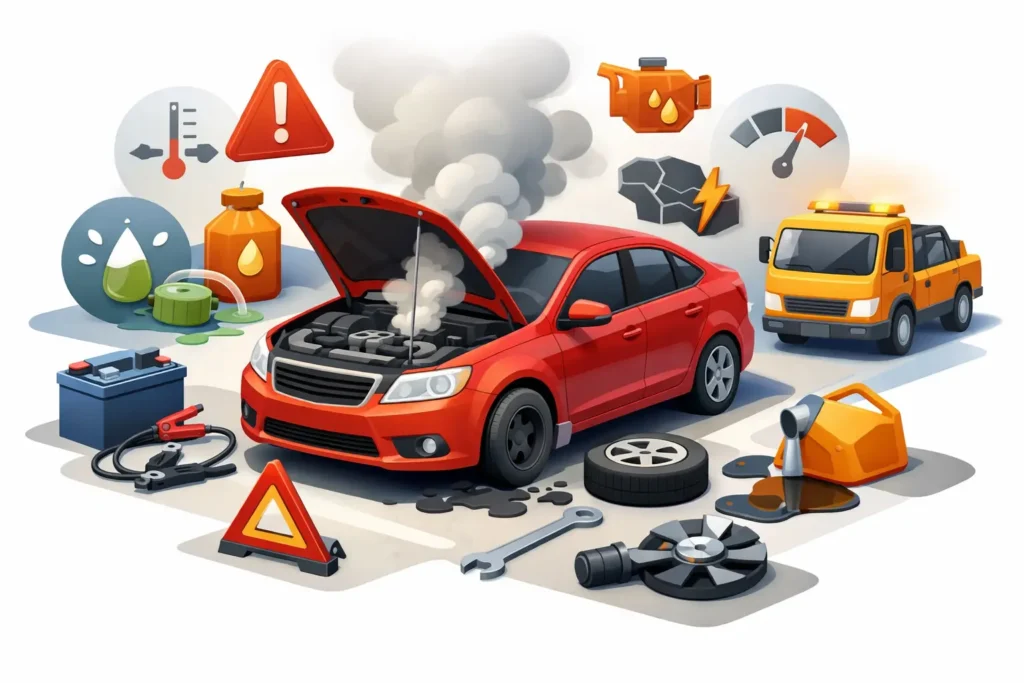
That dead-battery moment usually happens at the worst time – early for work, late for school pickup, or halfway through a packed Saturday. When drivers ask about the top reasons cars break down, the answer usually is not bad luck. Most breakdowns start with small problems that go unnoticed, get delayed, or are easy to miss if you are busy and your car still seems to run fine.
For drivers in Spring, Texas, reliability matters. You need your vehicle for work, errands, family schedules, and everything in between. The good news is that many common breakdowns are preventable when you know what to watch for and take care of issues before they leave you stranded.
Some vehicle failures happen suddenly, but most have a buildup period. A warning light may come on. A belt may start to squeal. The engine may crank a little slower each morning. Those clues matter because modern vehicles rarely go from perfect to disabled without some signal along the way.
The most common causes of breakdowns are battery failure, tire trouble, overheating, charging system problems, worn belts and hoses, brake issues, engine misfires, and neglected fluid maintenance. Not every issue creates an immediate emergency, but any of them can turn into one if ignored long enough.
A weak or dead battery is one of the most common reasons a car will not start. In many cases, the battery is simply old. Heat also plays a role, which matters in Texas. High temperatures can shorten battery life by speeding up internal wear, even if the battery seemed fine a few weeks earlier.
If your engine cranks slowly, your headlights look dim, or you need repeated jump-starts, your battery or charging system needs attention. Sometimes the battery is the problem. Sometimes the alternator is not recharging it properly. That is why testing matters instead of guessing.
Flat tires, blowouts, and damaged sidewalls can stop a trip fast. Some tire failures come from road hazards, but many start with low air pressure, uneven wear, missed rotations, or driving too long on worn tread. A tire that looks acceptable at a glance may still be unsafe.
This is one of those areas where small habits make a real difference. Checking tire pressure, rotating tires on schedule, and paying attention to vibration or pulling can help catch problems early. Waiting too long often turns a manageable tire service into a roadside issue.
An overheating engine can lead to serious damage in a short amount of time. Low coolant, a leaking hose, a failing water pump, a stuck thermostat, or a radiator problem can all cause temperatures to rise. In warm weather and stop-and-go traffic, those weaknesses show up faster.
If your temperature gauge climbs, steam comes from under the hood, or you smell coolant, do not keep driving and hope it clears up. Continuing to drive an overheating vehicle can turn a repair into engine damage, which is far more expensive and disruptive.
A lot of the top reasons cars break down trace back to delayed maintenance. That does not mean every driver is careless. Life gets busy. Oil changes get pushed a few weeks. Brake noise starts small. A coolant check gets overlooked because the car still feels normal.
The problem is that vehicles depend on fluids, filters, rubber components, and wear parts that all have service intervals for a reason. Oil loses effectiveness over time. Belts crack. Hoses weaken. Brake pads wear down. By the time symptoms feel obvious, the repair is often bigger than it needed to be.
Your engine depends on clean oil for lubrication and heat control. When oil gets too low or too dirty, internal engine parts face more friction and more wear. Ignore that long enough, and you can end up with poor performance, overheating, or major engine damage.
Some drivers assume they can stretch oil change intervals because the car still drives normally. Sometimes you can get away with that for a while. Sometimes you cannot. It depends on the vehicle, the oil type, your mileage, and your driving conditions. Short trips, heavy traffic, and high heat can all be harder on oil than people expect.
Belts and hoses do not get much attention until they fail, but they are critical parts of daily vehicle operation. A worn serpentine belt can affect your alternator, power steering, and air conditioning. A weak hose can leak coolant and contribute to overheating.
The challenge is that these parts often wear gradually. Cracks, glazing, softness, swelling, or small leaks may not seem urgent, but they are signs the part is reaching the end of its service life. Replacing them at the right time is usually much easier than dealing with the breakdown that follows.
Brake problems do not always cause a roadside breakdown, but they can absolutely leave a vehicle unsafe to drive. If pads wear down too far, they can damage rotors. If brake fluid leaks or hydraulic components fail, stopping power can be reduced.
Squealing, grinding, vibration, or a soft brake pedal should never be treated as a wait-and-see issue. Sometimes the fix is straightforward. If it gets ignored, the repair usually grows. More importantly, your safety margin drops.
Not every breakdown comes from a mechanical part you can see wearing out. Electrical issues can be harder to spot, especially when they start intermittently. A loose connection, failing alternator, blown fuse, weak starter, or damaged wiring can create frustrating symptoms that come and go before the car finally refuses to start.
This is where professional diagnostics save time. Replacing a battery because the car will not start may seem logical, but if the alternator is failing, the problem comes right back. A proper inspection helps identify the real cause so the repair is done correctly the first time.
Drivers often group these together with battery trouble because the symptoms overlap. If the battery is good but the starter is failing, the engine may click or struggle to turn over. If the alternator is weak, the battery may repeatedly die even after it has been charged or replaced.
The trade-off here is cost versus certainty. Guessing can feel cheaper in the moment, but repeated parts replacement gets expensive quickly. Accurate testing is usually the smarter path.
If your car cranks but does not start, runs rough, stalls, or lacks power, the issue may be tied to fuel delivery or ignition. Spark plugs wear out. Ignition coils fail. Fuel pumps weaken. Sensors can send incorrect information to the engine computer and affect how the vehicle runs.
Some of these problems build slowly, with rough idling or lower gas mileage. Others seem to appear overnight. Either way, they are not problems to postpone for long. A vehicle that stalls in traffic or struggles to accelerate is not just inconvenient – it can be unsafe.
Most breakdowns offer a warning, even if it is subtle. A check engine light, burning smell, fluid spot in the driveway, unusual vibration, squealing noise, or hard start all deserve attention. The same goes for steering changes, poor braking, or dashboard lights that flicker or stay on.
It is true that not every warning sign points to a major repair. Sometimes the fix is minor. But that uncertainty is exactly why inspection matters. Catching a small issue early gives you more options, more time, and usually a lower repair bill.
The best way to avoid common failures is to stay ahead of maintenance and respond early when something changes. That means routine oil service, brake checks, battery testing, tire inspections, fluid checks, and attention to belts, hoses, and warning lights. If your car has been running differently, even slightly, it is worth having it looked at before the problem gets worse.
For local drivers, working with a trusted neighborhood shop matters too. You want clear answers, honest recommendations, and repairs that solve the issue instead of masking it. At 360 Auto, that approach is part of helping families and commuters stay on the road with confidence.
No vehicle lasts on guesswork alone. The more consistent you are with maintenance, the less likely your car is to pick the worst possible moment to break down – and that peace of mind is worth a lot when your whole week depends on getting where you need to go.


