
- April 13, 2026
- By
- In Brakes
- 17
- 0
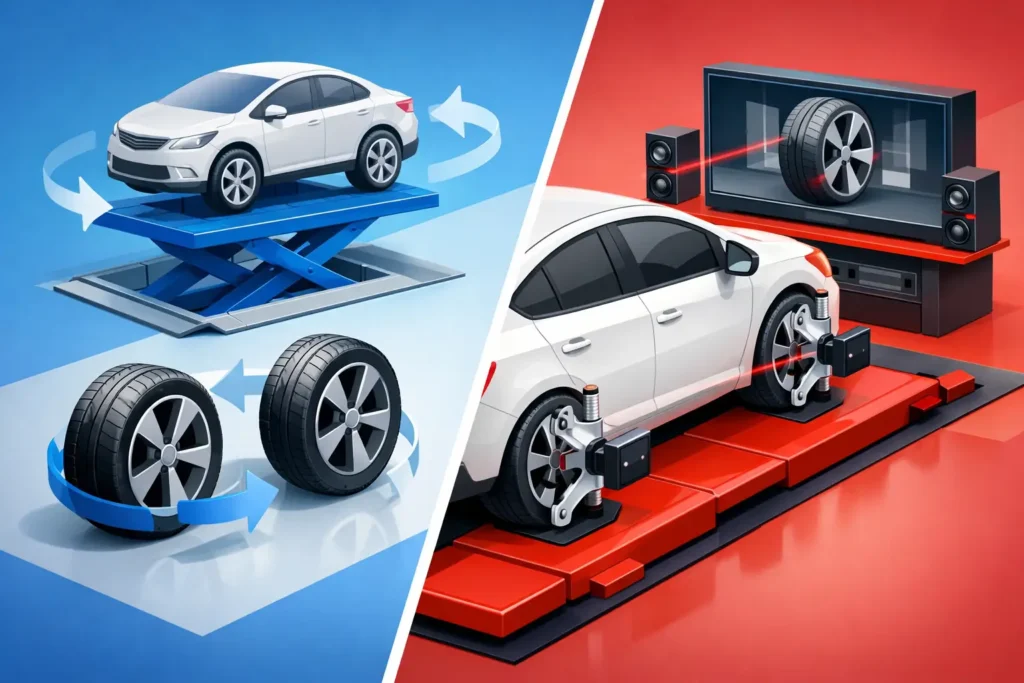
A lot of drivers hear the same question at the shop counter and hesitate for a second: do you need a tire rotation, an alignment, or both? When it comes to tire rotation vs alignment, the confusion is common, but the difference matters for your safety, tire life, and how your vehicle feels on the road.
These two services are often mentioned together because both affect your tires, but they solve different problems. One helps your tires wear more evenly over time. The other corrects how your wheels are positioned so your vehicle tracks properly. If you mix them up, you can end up replacing tires sooner than expected or driving with handling issues that only get worse.
Tire rotation is the process of moving your tires from one position on the vehicle to another. For example, the front tires may be moved to the rear, or the tires may be switched in a specific pattern based on your vehicle type and tire design. The goal is simple: even out tread wear.
Why does that matter? Because tires do not wear at the same rate. On many vehicles, the front tires wear faster due to steering, braking, and weight distribution. On front-wheel-drive vehicles, the front tires also handle engine power, which adds more wear. Rotating the tires helps spread that wear across all four tires so you get more usable life from the full set.
Alignment is different. A wheel alignment adjusts the angles of the wheels so they meet the road the way the manufacturer intended. Those angles affect how straight your vehicle drives, how the steering wheel sits, and how evenly the tires contact the pavement. If the alignment is off, your tires can wear unevenly very quickly, even if you rotate them on schedule.
So the short version is this: rotation manages tire wear by changing tire positions, while alignment corrects the direction and angle of the wheels.
A tire rotation is preventive maintenance. It does not repair damaged tires, fix steering problems, or correct suspension issues. What it does is help avoid uneven wear caused by normal driving.
If you stay current on rotations, you are more likely to get the full value out of your tires. You may also notice a smoother ride over time because the tread wears more consistently. For families, commuters, and anyone putting regular miles on a vehicle around Spring, that can make a real difference in long-term tire cost.
Most vehicles need a tire rotation about every 5,000 to 7,500 miles, but the exact timing depends on the manufacturer, tire type, and driving conditions. Stop-and-go traffic, rough roads, hard braking, and heavy loads can all affect wear patterns. That is why a set schedule is helpful, but inspections still matter.
If a tire is already cupped, badly worn on one edge, or damaged, rotation alone may not solve the issue. It may simply move the problem to another corner of the vehicle.
An alignment is about control, tracking, and tire contact with the road. When the wheel angles are off, the vehicle may pull to one side, the steering wheel may sit crooked, or the tires may scrub against the road instead of rolling cleanly.
That kind of wear can get expensive fast. A vehicle with poor alignment may wear through the inside or outside edge of a tire long before the rest of the tread is gone. In some cases, the tire still looks fairly new at a glance, but one edge is nearly bald.
Alignment problems can show up after hitting a pothole, bumping a curb, replacing suspension parts, or simply from wear over time. Even daily driving can gradually affect alignment, especially on roads with frequent dips, rough patches, or construction damage.
An alignment does not move the tires around. It adjusts suspension and steering angles so the tires sit and track correctly. That is why it addresses handling concerns in a way tire rotation cannot.
Some symptoms point clearly to one service. Others overlap.
If your vehicle feels normal and drives straight, but your tires are wearing faster on the front than the rear, a rotation may be all you need. This is especially common when routine maintenance has been delayed.
If your car pulls left or right, the steering wheel is off-center while driving straight, or you notice rapid wear on just one edge of the tire, alignment becomes the bigger concern. Those are not normal rotation issues.
Sometimes both services make sense together. For example, if your tires are due for rotation and the technician notices uneven edge wear or a steering concern, an alignment check is the logical next step. Rotation helps preserve the tires you have. Alignment helps stop the pattern that is wearing them out.
A few warning signs deserve quick attention:
Not every vibration means an alignment issue. It could also point to tire balance, damaged tires, or suspension wear. That is where a proper inspection matters more than guessing.
Drivers sometimes assume one service replaces the other. It does not.
You can rotate your tires right on time and still ruin them with bad alignment. You can also correct the alignment and still shorten tire life by never rotating them. The two services work best together because they address different causes of tire wear.
Think of rotation as even maintenance and alignment as directional correction. One spreads out normal wear. The other prevents abnormal wear.
There is also a cost difference to consider. Rotation is usually a routine, lower-cost service. Alignment is more specialized because it involves measurements and adjustments to wheel angles. But skipping alignment when the vehicle needs it can cost far more in premature tire replacement.
That is the trade-off. Saving money in the short term by passing on an alignment can lead to buying tires much sooner than planned.
For most drivers, tire rotation should happen regularly throughout the life of the tires. Many shops recommend it with oil change intervals, depending on the vehicle and oil type. That makes it easier to remember and helps catch wear issues early.
Alignment is usually not needed on a fixed mileage schedule in the same way, but there are times when it is smart to check it. If you notice handling changes, install new tires, replace steering or suspension components, or hit something hard enough to jolt the vehicle, alignment should move up the priority list.
Some vehicles are more sensitive than others. Larger wheels, lower-profile tires, and certain suspension setups may show alignment problems faster. Driving habits matter too. A commuter who regularly hits rough roads may need alignment checks more often than someone driving mainly smooth highways.
Ignoring tire rotation usually means uneven tread wear builds gradually. You may lose usable tire life, and road noise can increase as the tread pattern becomes less even. In some cases, the ride may start to feel rougher.
Ignoring alignment can create more serious problems. Uneven tire wear can happen quickly, fuel efficiency may drop, and the vehicle may become less predictable during braking or cornering. Over time, alignment-related wear can also put extra stress on suspension and steering components.
That is why this is not just about getting the most miles from a set of tires. It is also about keeping your vehicle safe and comfortable to drive every day.
For most drivers, the best approach is not choosing between tire rotation vs alignment. It is knowing what your vehicle is telling you and staying ahead of the problem.
If your tires are simply due based on mileage, rotation is part of good routine maintenance. If your vehicle pulls, your steering feels off, or tire wear looks uneven in a specific pattern, alignment deserves attention right away. And if both timing and symptoms line up, doing both can protect your tires and restore proper handling at the same time.
At a trusted neighborhood shop, the goal should never be to sell a service you do not need. It should be to inspect the vehicle honestly, explain what is happening clearly, and help you make the right call for your safety and budget. That is the kind of service local drivers count on.
When your vehicle starts feeling different, small signs are worth paying attention to. Catching tire wear and alignment issues early is one of the easiest ways to keep your car driving straight, riding smoother, and lasting longer.


